Avarra
Avarra was the old kingdom that bound the Realms through roads, tribute, and negotiated charters before the Crownfall broke its center.
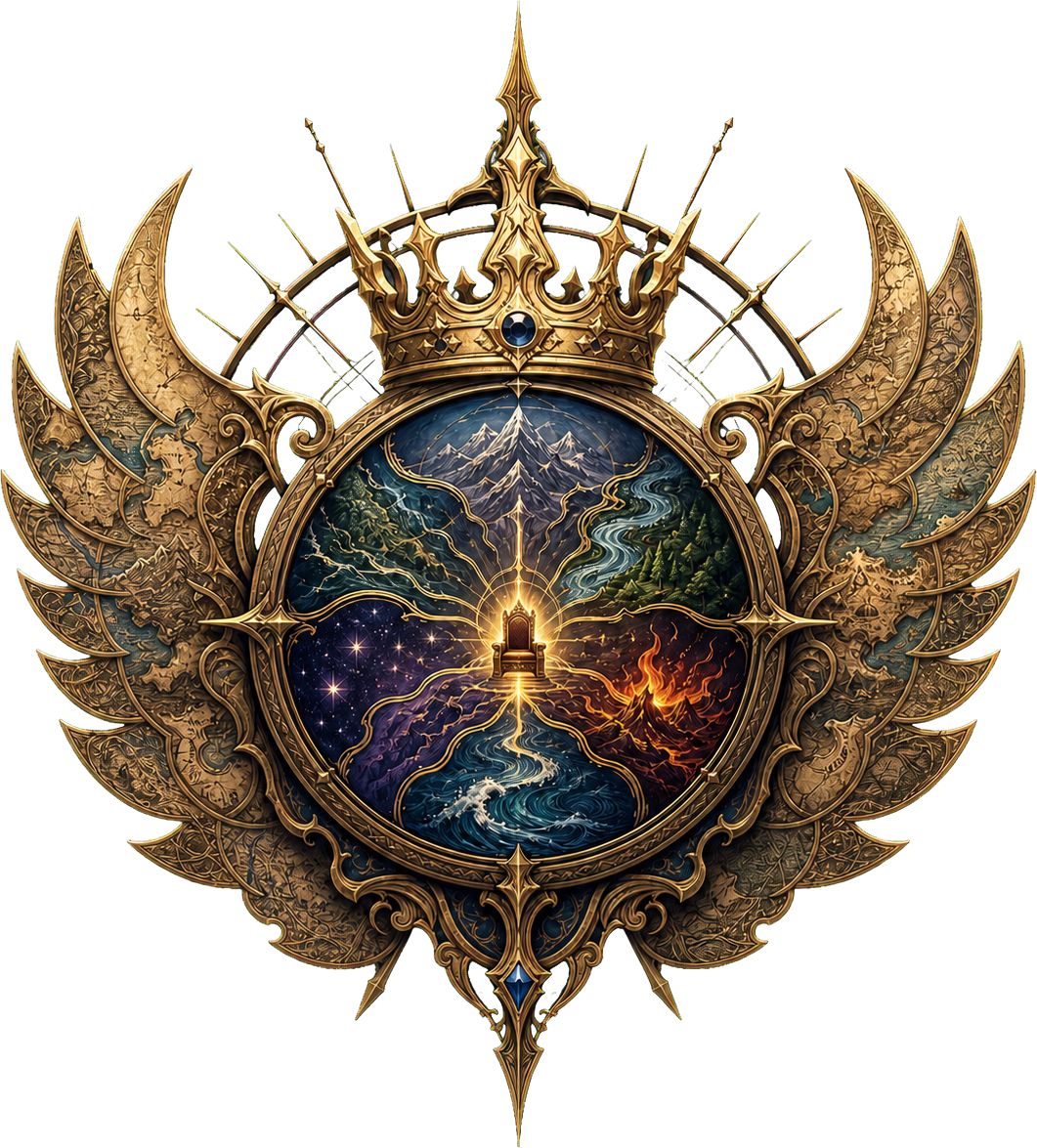 Tribute of the Twelve Realms
Shadow of God Publishing presents
Claim realms. Command tribute. Forge a dynasty.
A 126-card game of tribute and treachery for one to six rulers. Hold three complete Realms and the crown is yours — if the table lets you keep them.
Both run about half a minute. Sound is on — press play.
Six territories animated from their printed faces, shown in game the moment a claim lands. Choose a realm below.
Four moments from a real match. Every turn is some combination of these.
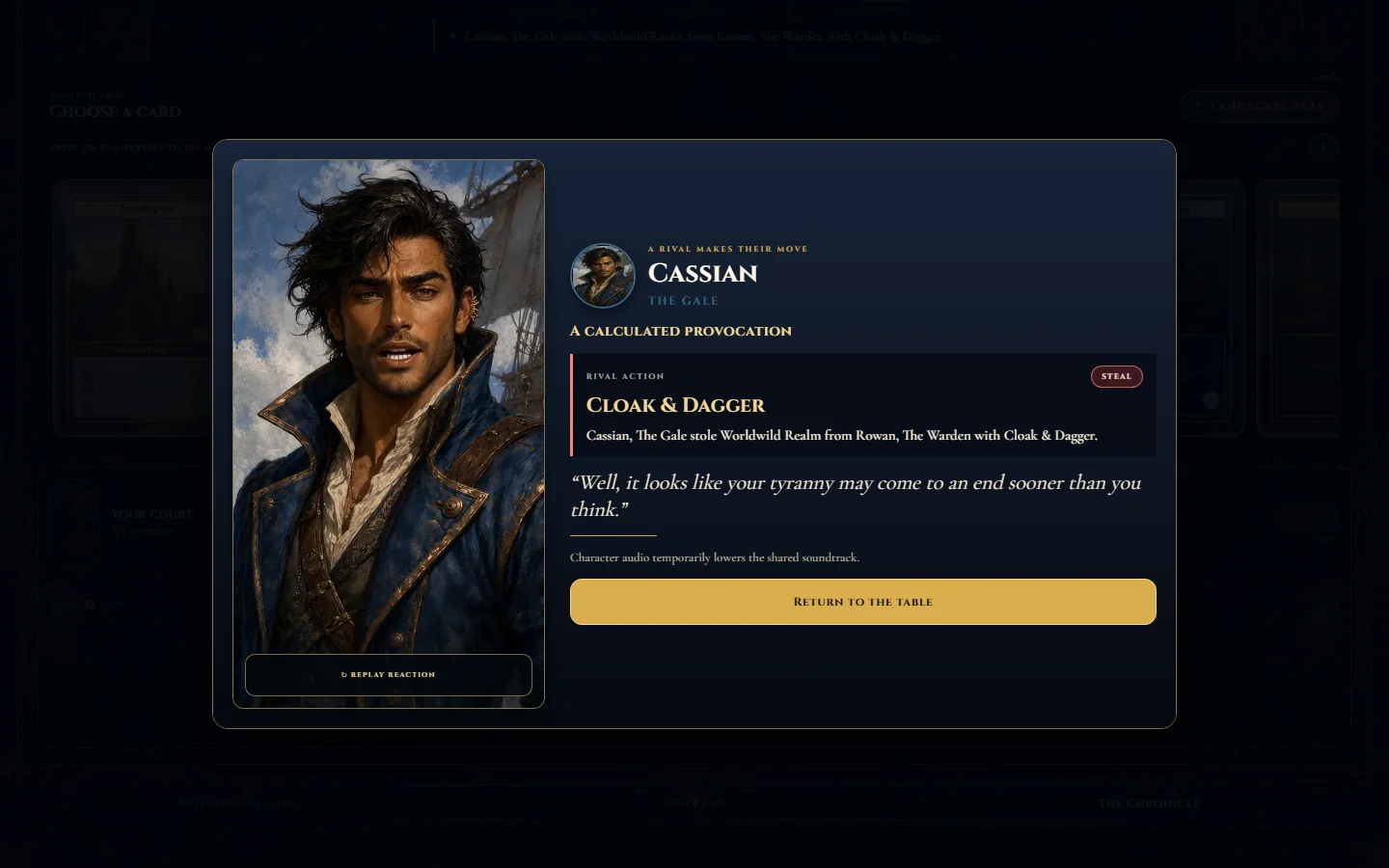
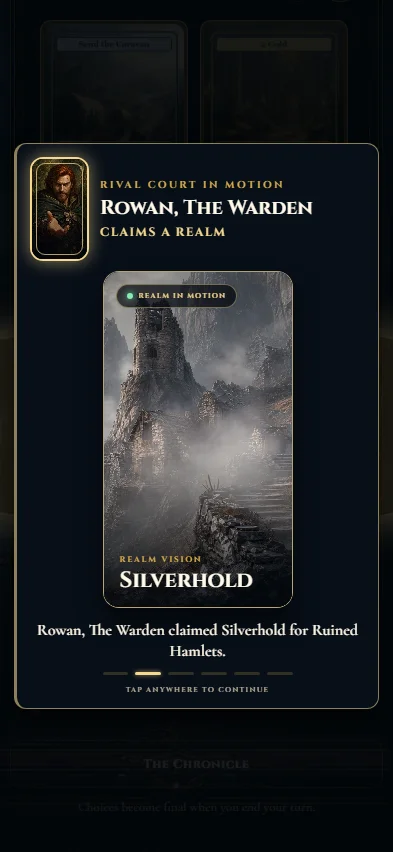
A rival lifts a Realm card straight out of your unfinished set.
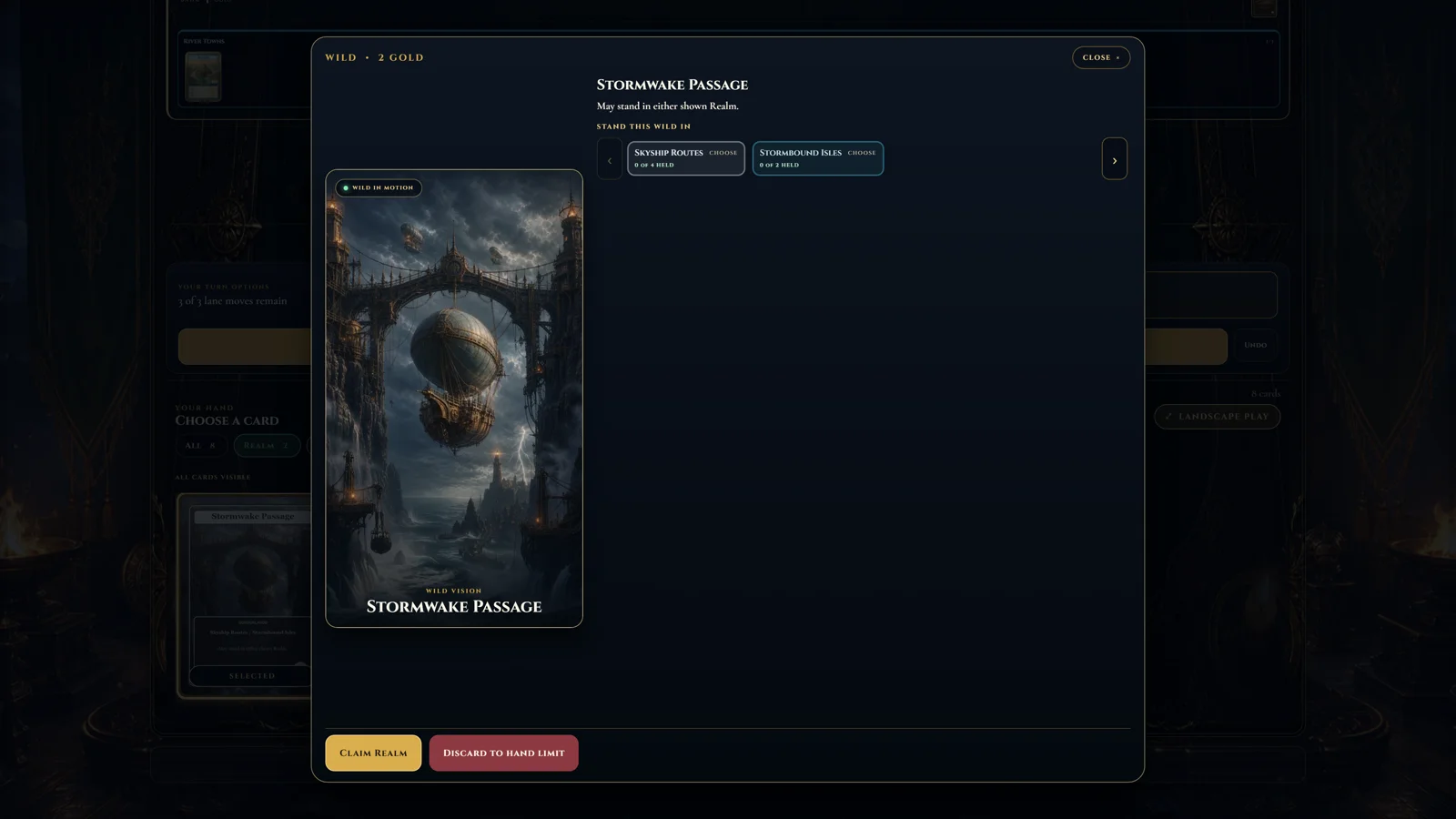
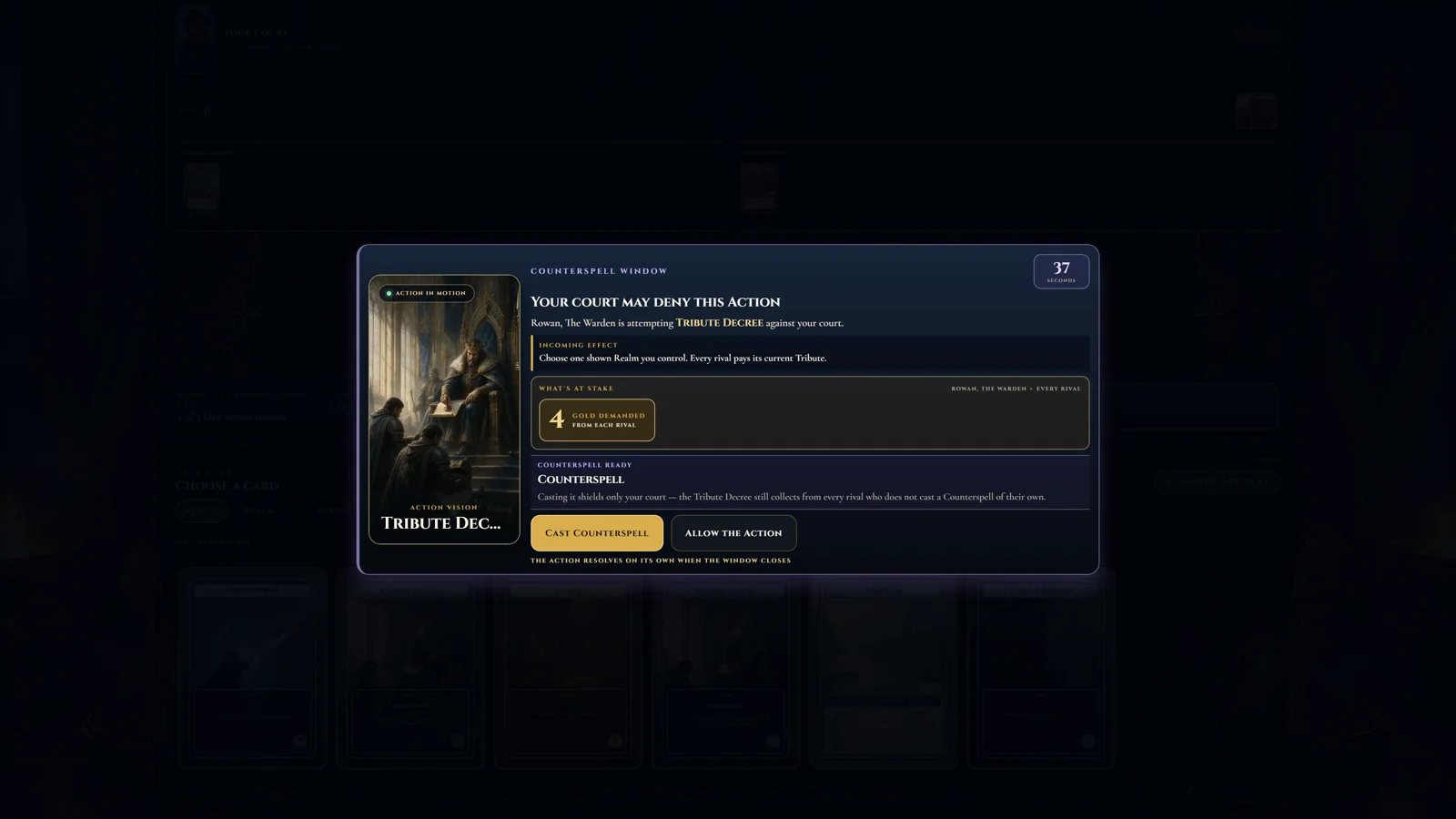
An Action aimed at you is cancelled — and the cancel can be cancelled back.
A decree lands and every rival hands over Gold. No change is given.
Seven cards, three lanes, one turn to decide which of them matters.
Every turn is the same three decisions. Every turn, someone tries to undo yours.
Each turn opens with two cards. Your hand tops out at seven, so what you throw away is already a decision.
You may claim one Realm, play one Action, and bank one Gold or Action card to your Treasury — Realms can never be banked — one of each, every turn. Banked cards are the only thing that counts as gold. The Realms on your board are territory, never currency.
Name a Realm you control and every rival pays its Tribute. They choose what to hand over, no change is given, and a ruler who cannot cover the demand surrenders what they have and walks away owing nothing. There is no debt in Avarra — only ruin.
Any Action aimed at you can be cancelled — and the cancellation can be cancelled, back and forth, for as long as the two of you still hold Counterspells. Cancel a Tribute Decree and only you are spared. The rest of the table still pays.
Three complete Realms wins. Conquest can tear a finished Realm off a rival outright, so no lead is safe until the last card falls.
Eight Actions in the 126-card deck, printed exactly as they read on the card. Copies in the deck, then the card's own Gold value.
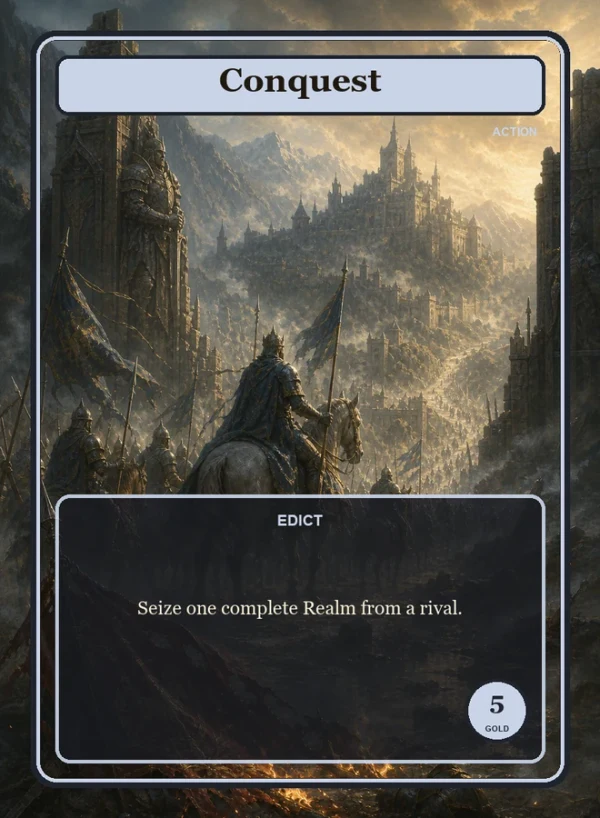
“Seize one complete Realm from a rival.”
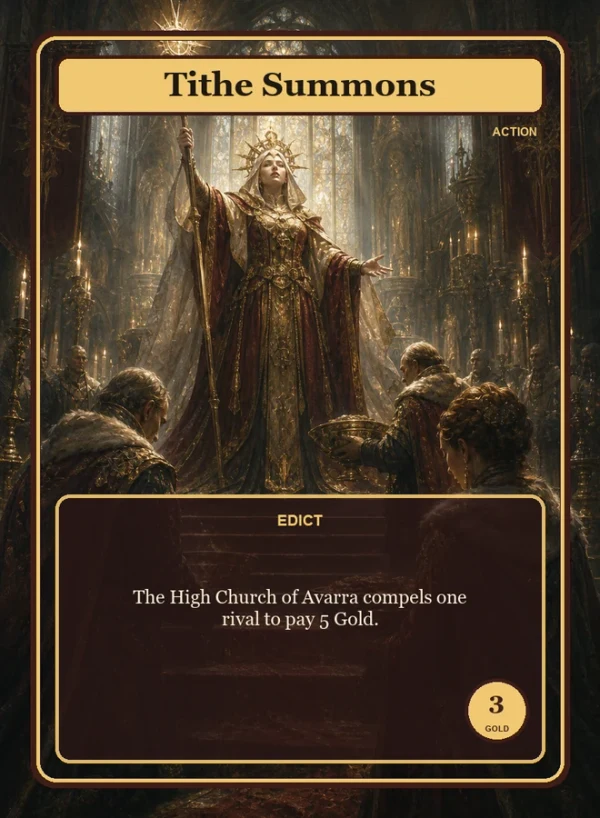
“The High Church of Avarra compels one rival to pay 5 Gold.”
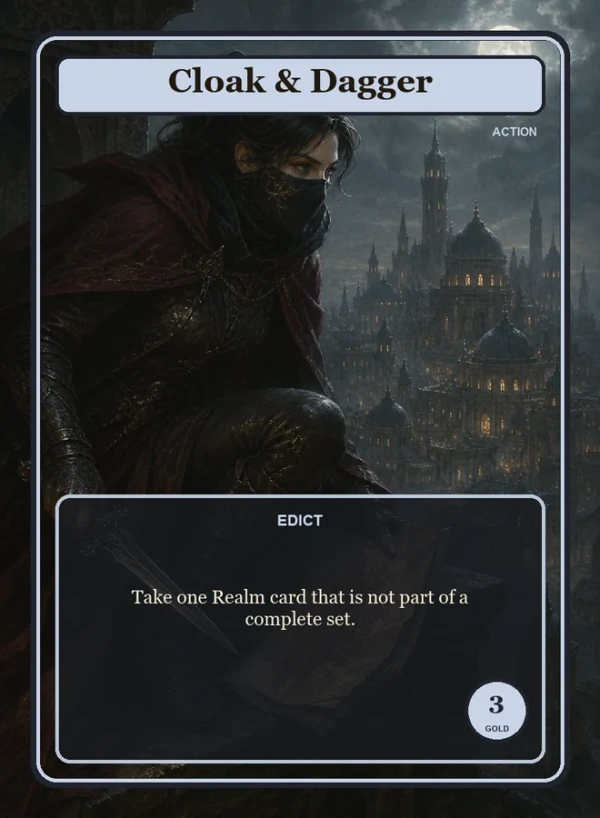
“Take one Realm card that is not part of a complete set.”
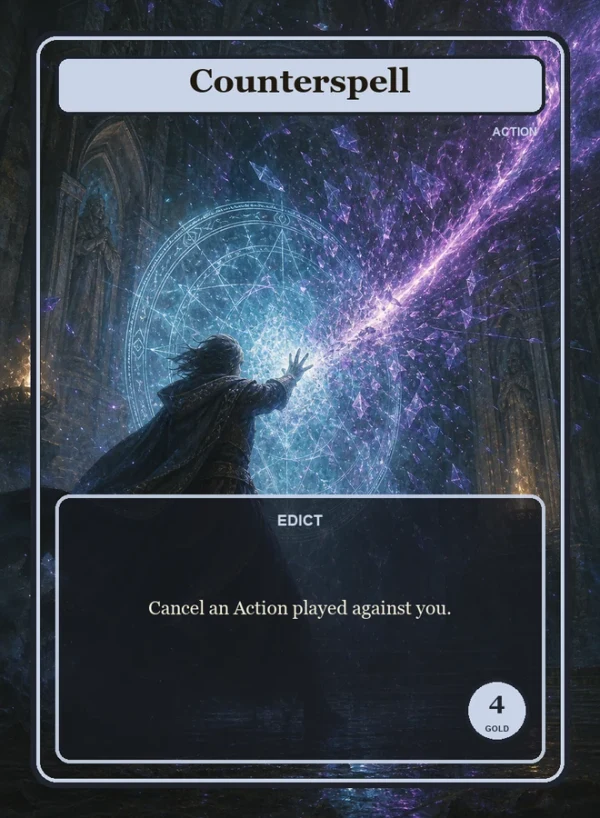
“Cancel an Action played against you.”
“Choose one shown Realm you control. Every rival pays its current Tribute.”
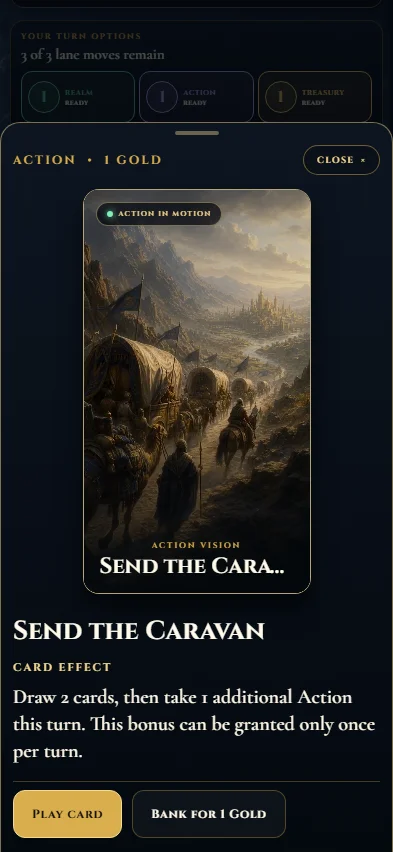
“Draw 2 cards, then take 1 additional Action this turn. This bonus can be granted only once per turn.”
“Trade one of your Realm cards for one rival Realm card.”
“One-time bonus: your next Tribute Decree demands double Tribute, then this is spent.”
Avarra was the old kingdom that bound the Realms through roads, tribute, and negotiated charters before the Crownfall broke its center.
The Crown was Avarra's secular monarchy. Its seals, ledgers, and succession evidence now empower rival claimants rather than one accepted ruler.
The High Church of Avarra survived the Crownfall as an independent network of sanctuaries, schools, courts, and tithe offices. Some clergy protect the displaced; others turn old summons into political weapons.

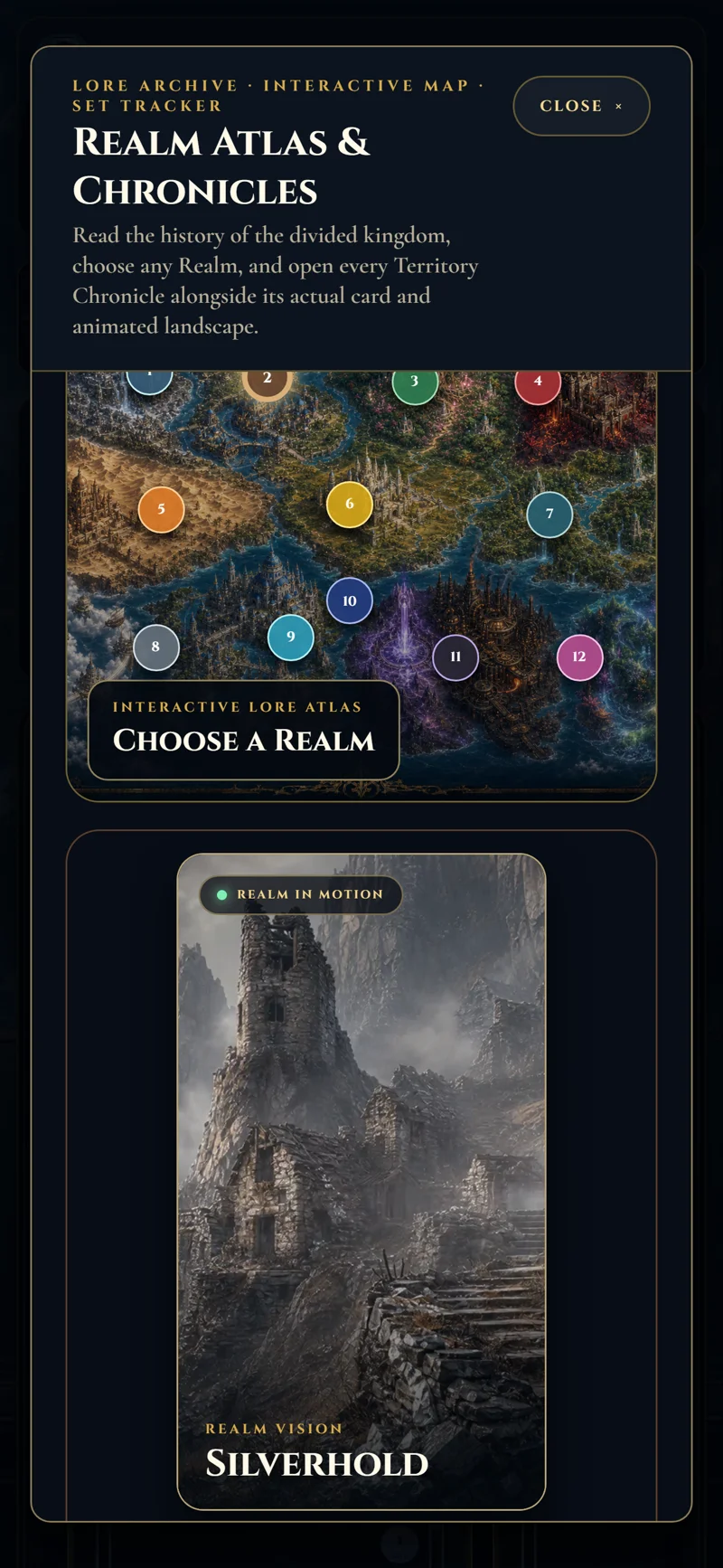
Twelve Realm families, thirty-two territories. Collect a family in full and it is a Realm; hold three and you are sovereign. The ladder beside each name is the Gold every rival owes as the set fills.
Open a realm to read its chronicle and territories
The high valleys once paid Avarra in silver and compulsory levies. When exhausted mines could no longer satisfy the Crown, the Collector's War burned the roads and helped ignite the Crownfall. The surviving hamlets now share warning fires, hidden granaries, and the mint records proving their ancient debt was paid. Every new ruler wants those records—or wants them destroyed.
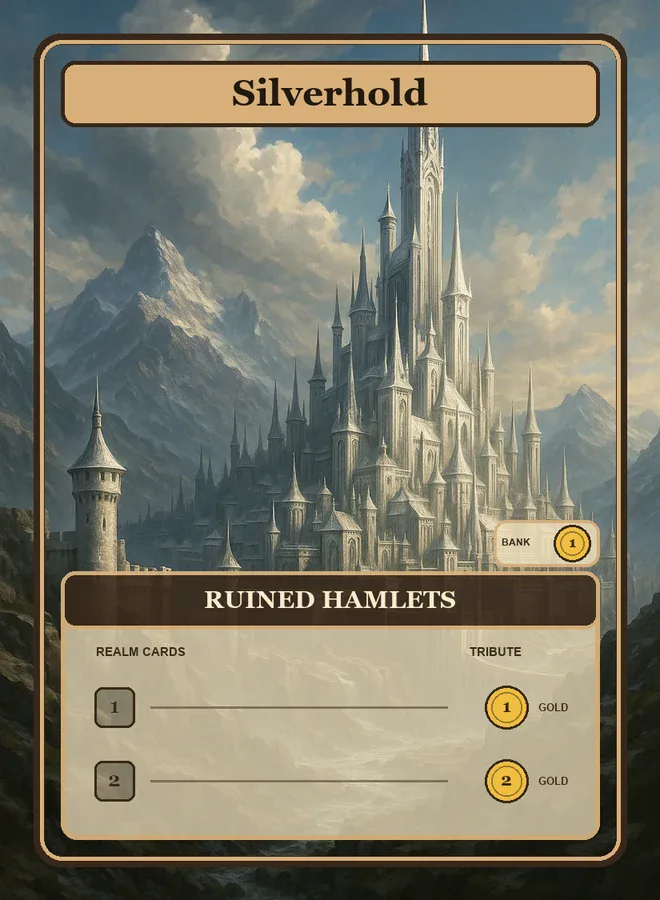
Silverhold is a small ring of slate roofs around a sealed mine. Inside its chapel lie the old mint dies and ledgers showing generations of tribute paid twice. Claimants to Avarra's throne offer fortunes for that evidence; the hearth council answers by moving one die each winter and telling no household where the others sleep.
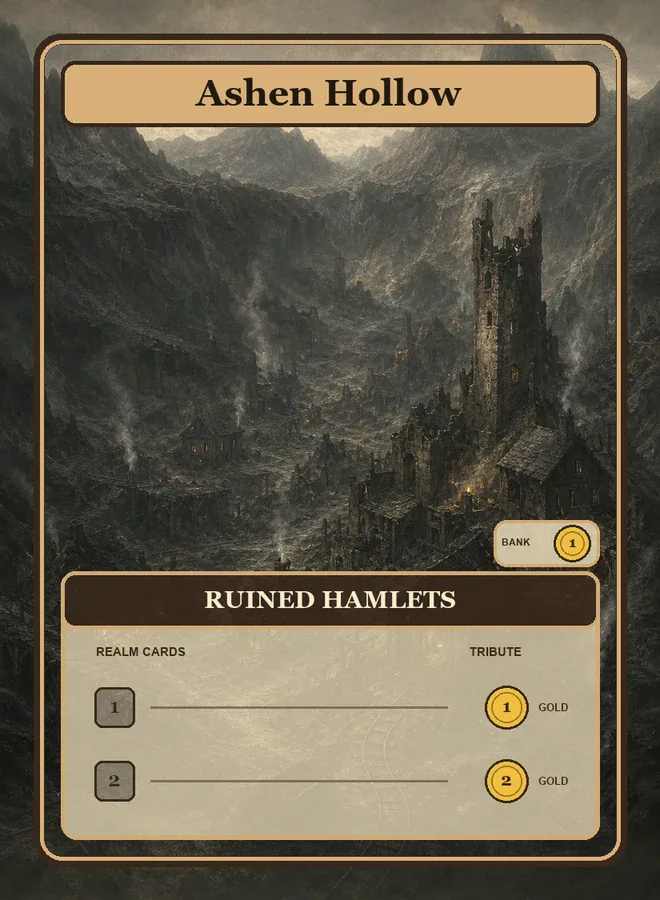
Ashen Hollow was rebuilt after the Collector's War, the mountain campaign that widened into the Crownfall. Its homes face one shared hearth, while false cairns turn invading columns back into the weather. The pale ash orchard fruits only after a bloodless year, so every feud threatens both the harvest and the Hollow's hard-won tribute.
The River Towns were built by ferrymen, millers, floodwardens, and shipwrights rather than kings. Their blue flood banners place every private boat and waterwheel under public command when the Lyr rises. Merchant houses resent that authority but depend upon it. Grain tolls, messages, and caravan crossings make the towns wealthy enough to attract both Royal Decrees and attempted Conquest.
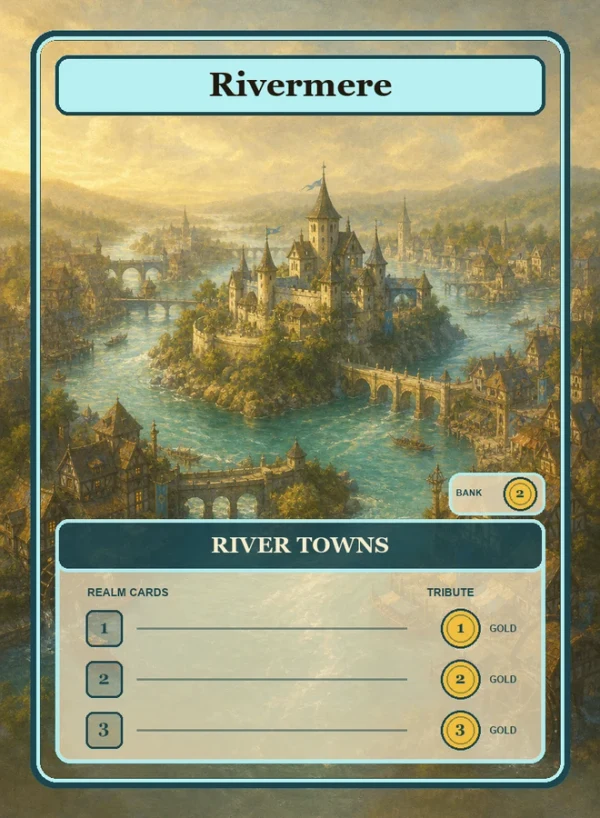
Rivermere's floating market follows the Lyr across a hundred reed-bound islands. Painted flood marks price every warehouse, while the elected Tidekeeper can seize any vessel for rescue. Traders profit from grain and caravan traffic, yet a growing faction refuses to let emergency powers become permanent rule after each flood.
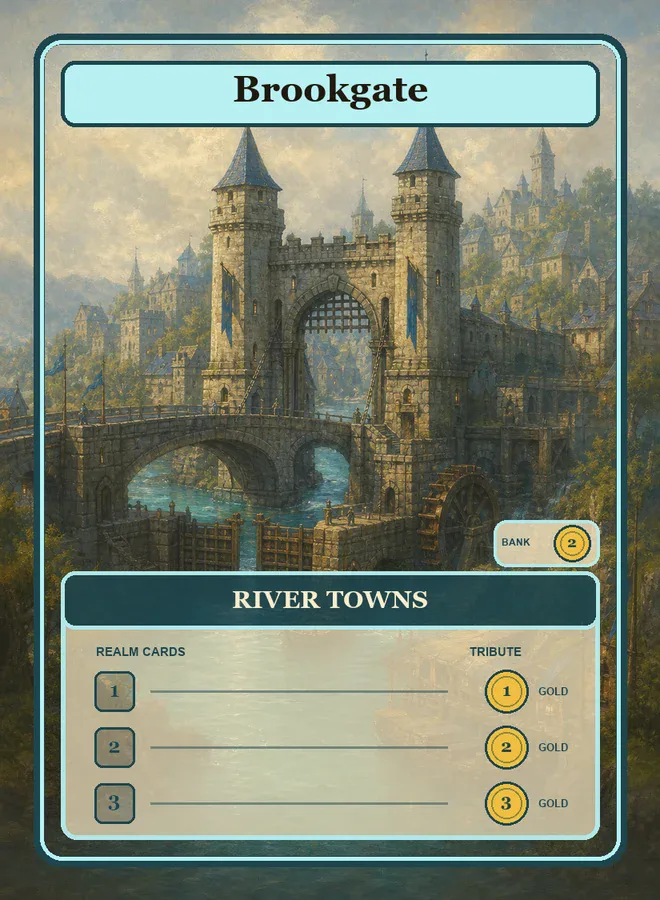
Brookgate keeps the Crown's rusted toll-chain raised above the river as a warning. Below it, blue-bannered lock crews and waterwheels can open trade, stop a fleet, or flood the eastern road. Every ruler wants the gates; every lockwright swears the river will never again become royal property.
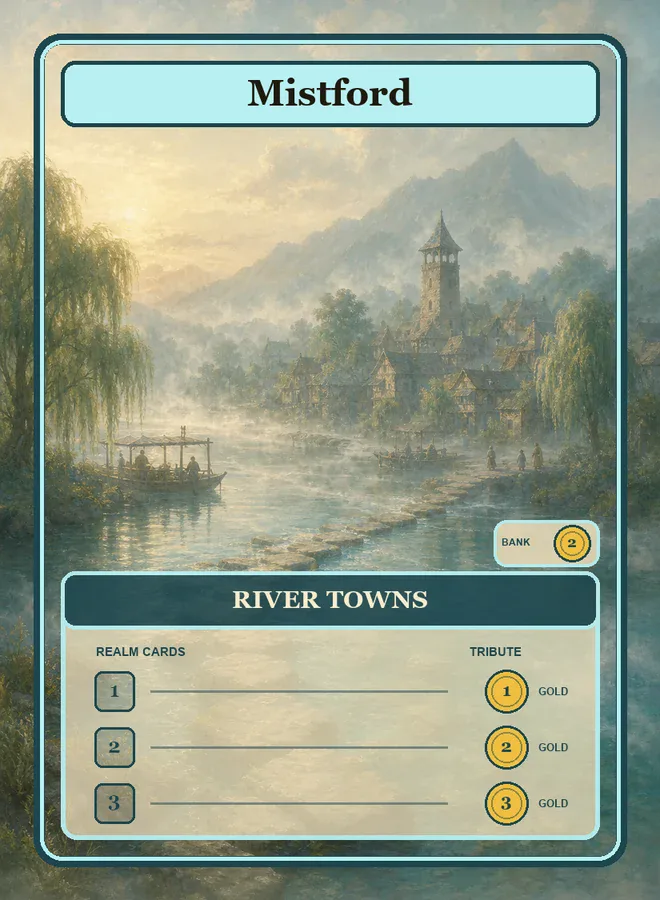
Mistford ferried three rival armies across the same fogbound channel during the Crownfall and betrayed none. That neutrality now makes it the favored ground for ransoms and secret exchanges. Its guides charge heavily because keeping the crossing neutral requires refusing friends as often as enemies—and remembering every debt without recording a name.
The Glades obey the Blooming Law: the forest gives visible form to the consequences of a promise, but never reveals whether that consequence is reward or punishment. Seasonal circles interpret each new bloom and sell rare dyes, memory-resin, and oath witness to outsiders. Their wealth comes from meaning itself, which makes every bargain valuable and every careless agreement dangerous.
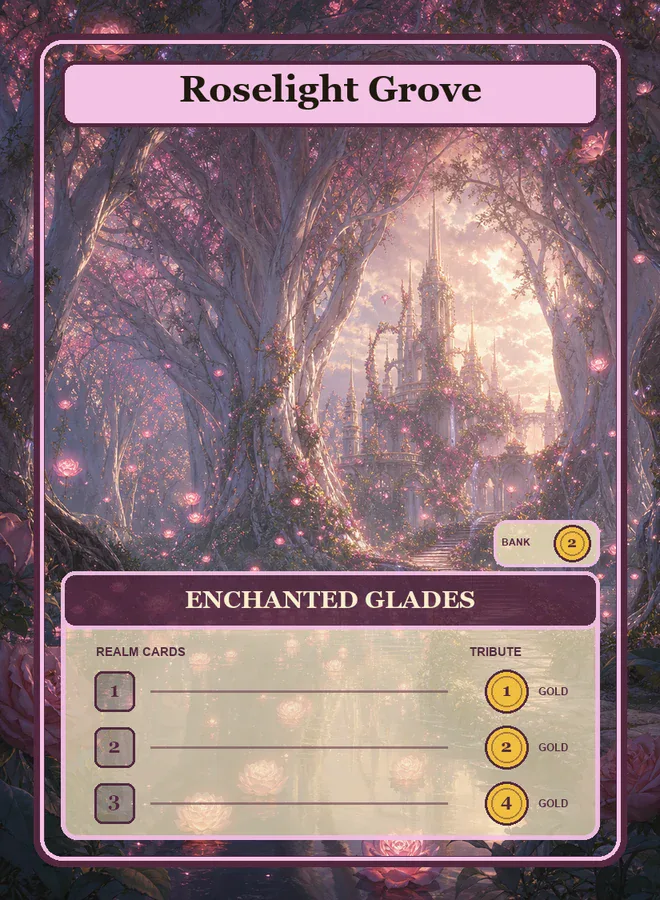
Roselight Grove records promises in color. New vows tint its blossoms; broken ones leave black veins that never fade. The grovekeepers sell dyes copied from honorable blooms and refuse pigment from betrayals. Courts prize Roselight cloth because a false treaty signed upon it stains before the ink dries.
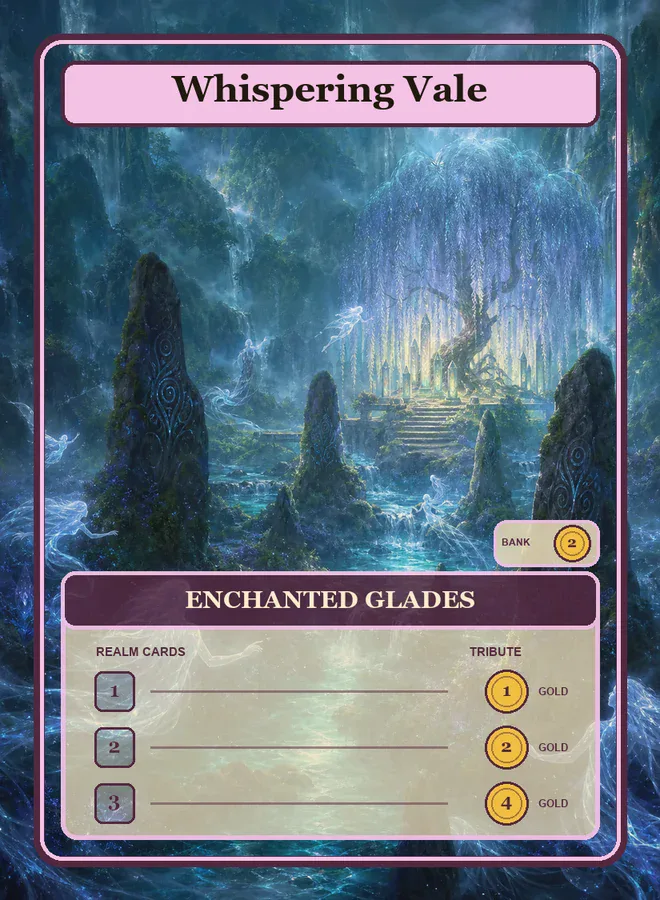
Whispering Vale returns a speaker's words only after their consequences become clear. A warning may echo tomorrow or after its author is dead. Envoys and spies pay to hear old councils completed, while the Vale's keepers decide which delayed voices may leave the hills and which would reopen a settled war.
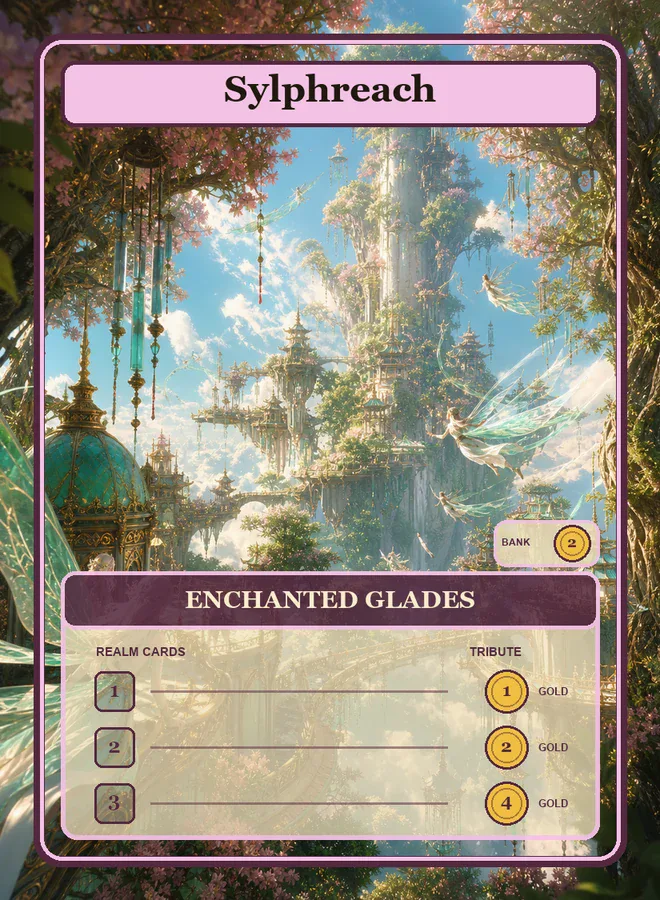
Sylphreach grows pale towers and root bridges through wind-bent trees above the dawn mist. Its reed choirs send messages whose pitch changes when the sender conceals intent. The settlement guards the Glades' highest border and earns its tribute carrying warnings no forged seal can imitate.
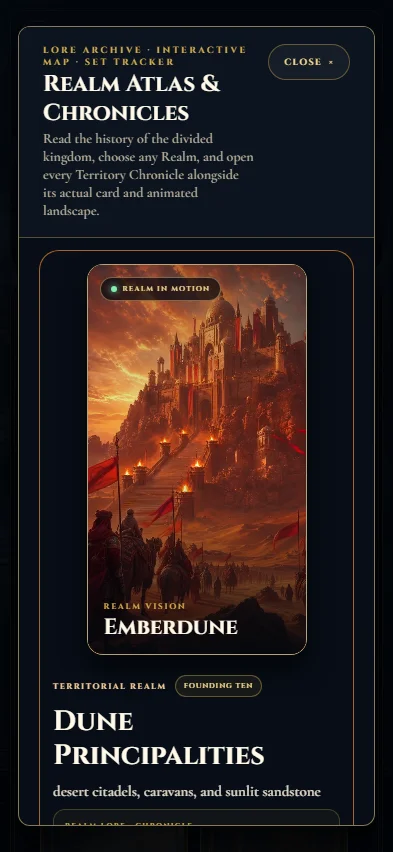
The principalities form the Mirror League, a chain of sandstone cities linked by reflected signals and the buried Glass Road. Each city chooses a First Lens to align its beacons with the league; any ruler who hoards water or falsifies a signal loses that alignment. Their star archive fixes the Crownfall's true date, making the League's records as valuable as its caravan tolls and heat-glass craft.
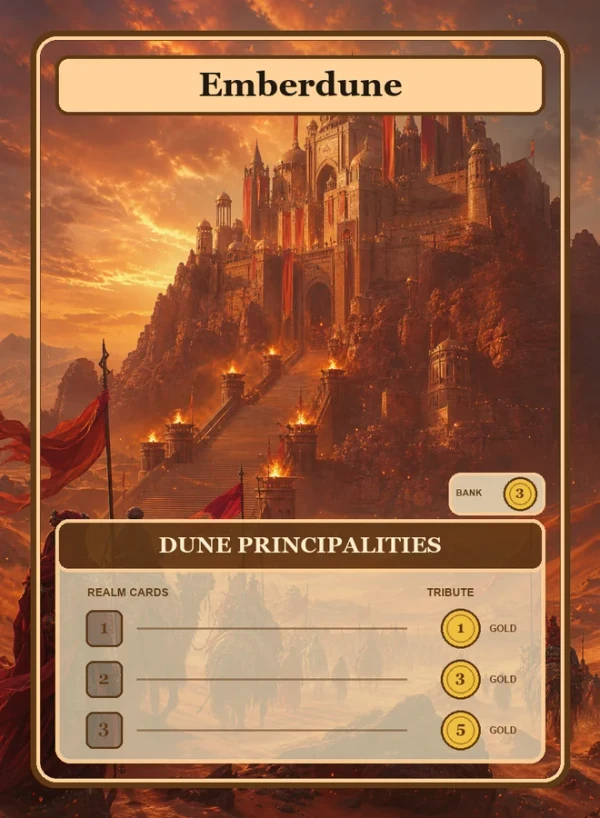
Emberdune's copper kilns once fused an entire work yard into black glass. Rather than hide the disaster, its artisans learned to cut heat mirrors from it. During each election, candidates align those mirrors to light the public cistern at dawn; a failed alignment ends the candidacy before a single vote is counted.
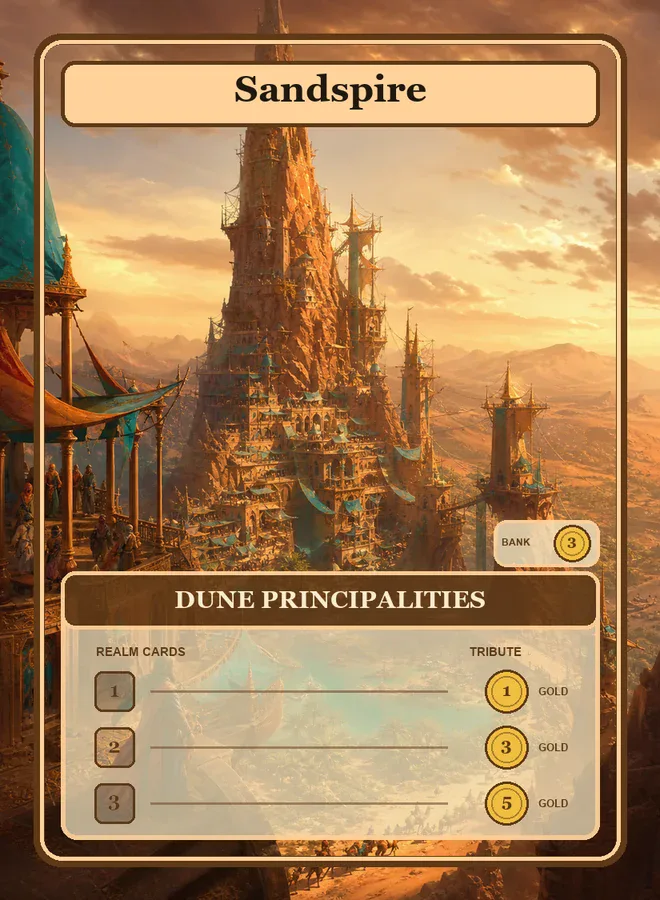
Sandspire shades its communal well with stacked sandstone terraces and lapis screens. Water is allotted publicly, but the city bears the costly duty of maintaining three Glass Road beacons for every caravan. Its fiercest disputes concern whether distant travelers or crowded neighborhoods receive the next measure when a mirror goes dark.
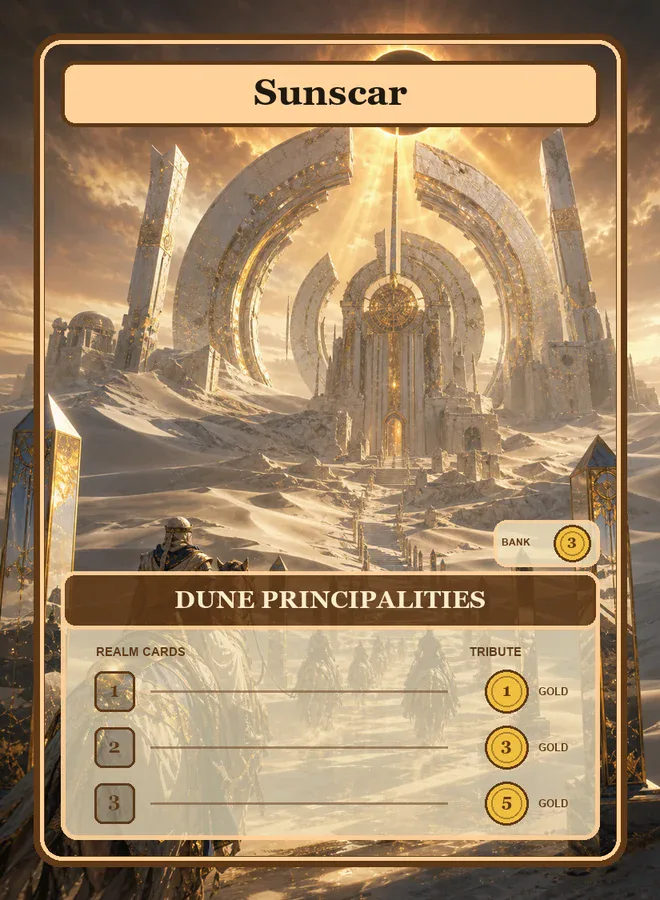
Sunscar houses the Mirror League's star archive inside a citadel cut along a pale fault in the plateau. Its copper roof tracks both stars and noon shadow without using the royal calendar. Scholars proved the Crown announced its own fall eleven days late; rival claimants now pay dearly for records supporting their succession.
The Crimson Keeps were Avarra's western ward-chain: fortress towns paid in iron, trained companies, and guarded caravans. After the Crownfall, their captains divided over whether service belonged to the vanished Crown, the High Church, or the people behind their walls. Their red beacons still answer one another, but every summons now tests a different allegiance.
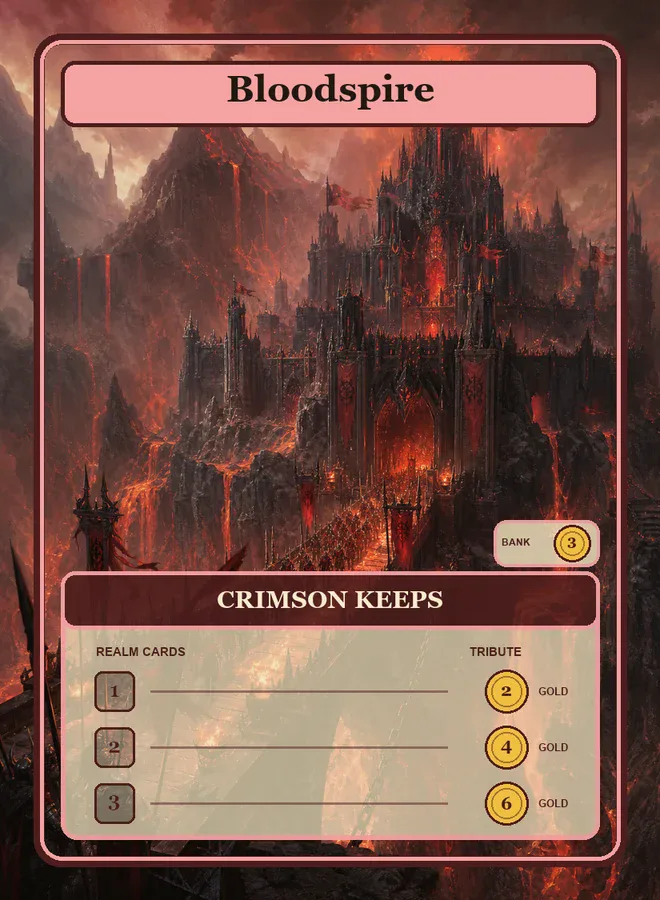
Bloodspire rises in red-veined basalt above the western muster ground, where company oath-banners line the central stair. Later archivists matched covert notches beneath those carvings to secret Church warrants. The discovery can legitimize a commander's service, expose a false oath, or make an old military house pay heavily for silence.
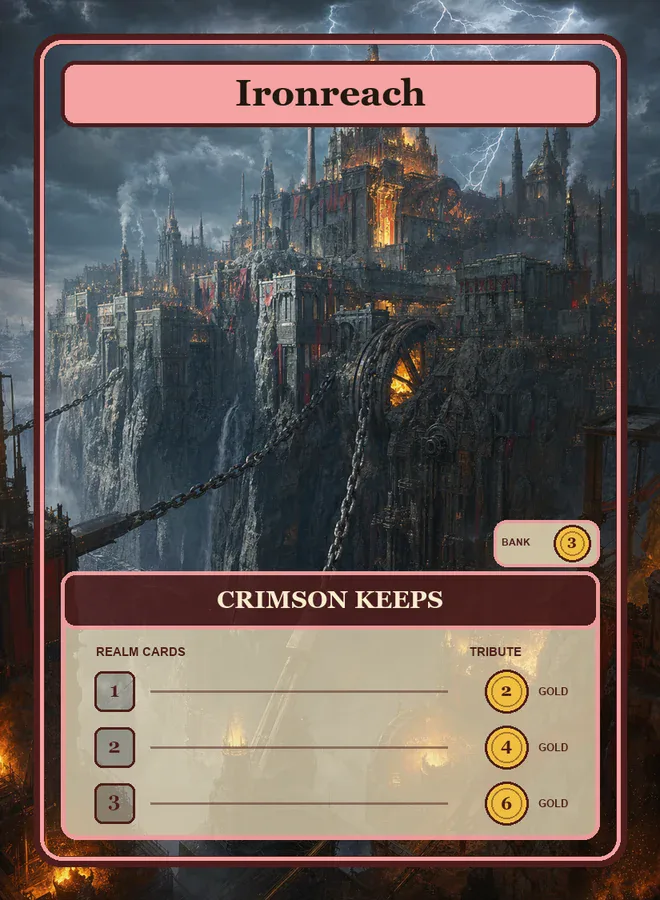
Ironreach spans a gorge with foundries on one rim and crowded workers' wards on the other. Its chain bridges carry armor and caravan wagons, but can be dropped during invasion or strike. The forge syndics demand higher tribute for every war beyond the walls, forcing ambitious captains to bargain before they march.
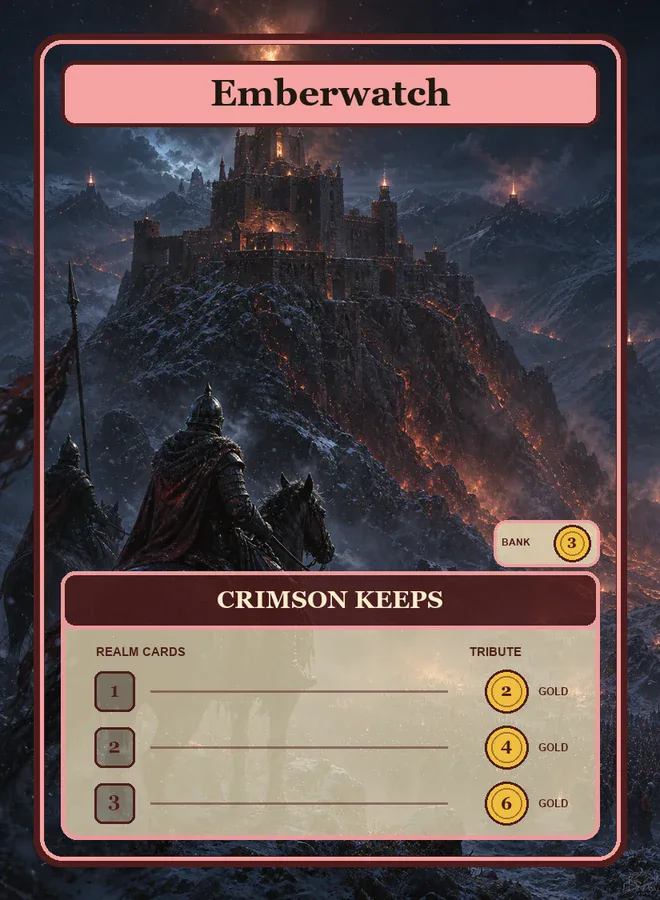
Emberwatch's coal-bright beacon guards the western road. Its sanctuary steward records arriving refugees despite the garrison captain's protests. Because one false signal began a border war, the captain, steward, and civilian signaler now hold separate keys; all three offices must consent before the tower summons the Crimson chain.
The Sunlit Plains feed more Realms than any crown ever governed. Beneath cornflower-blue harvest banners, councils control the granary seals while landholding houses command mills, cavalry, and the best roads. Both remember when Avarra and its High Church claimed separate tithes from one crop. Grain sales fund the Plains' Gold tribute—and make withheld caravans a weapon.
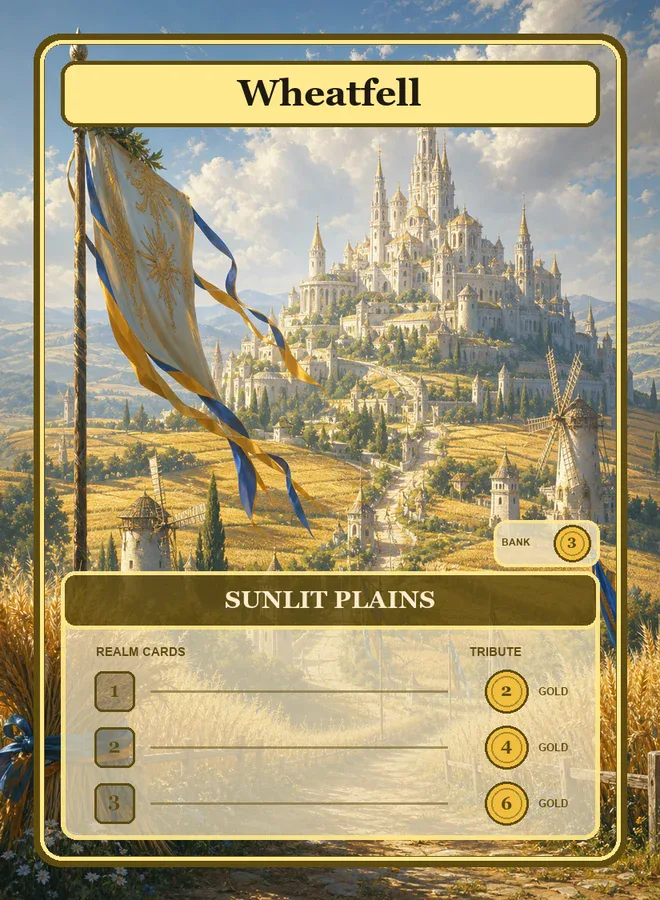
Wheatfell's windlass hoists raise grain into stepped storehouses hung with blue harvest banners. Its cooperatives can fill a royal caravan overnight, yet refuse any seal not approved by the harvest council. When Crown and Church collectors both arrive, the hoists stop—and Gold from the grain markets stops with them.
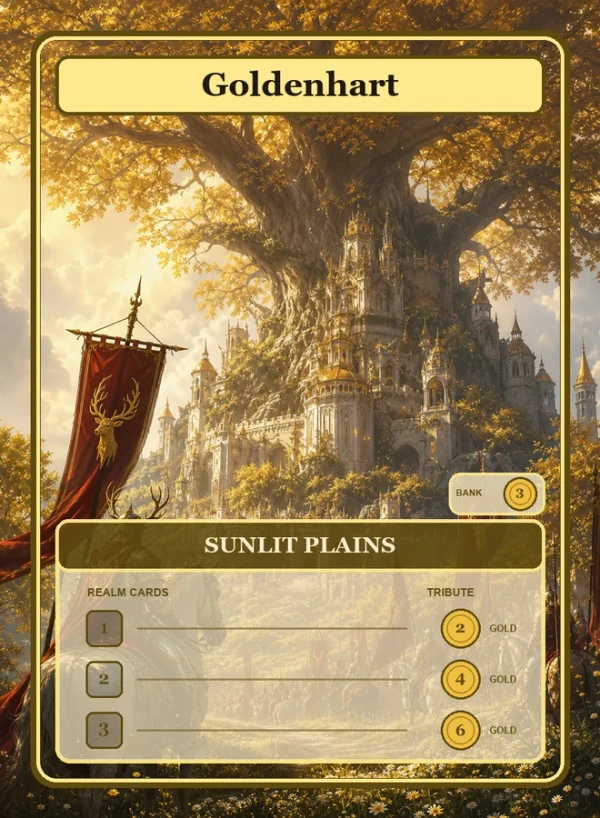
Goldenhart breeds swift dun horses for couriers across the Plains. Each registered horse-line owes its first service to the blue-pennant public roads before private war. Breeding houses want to sell the finest teams abroad; roadwardens insist that losing them would surrender the Realm's messages before any battle begins.
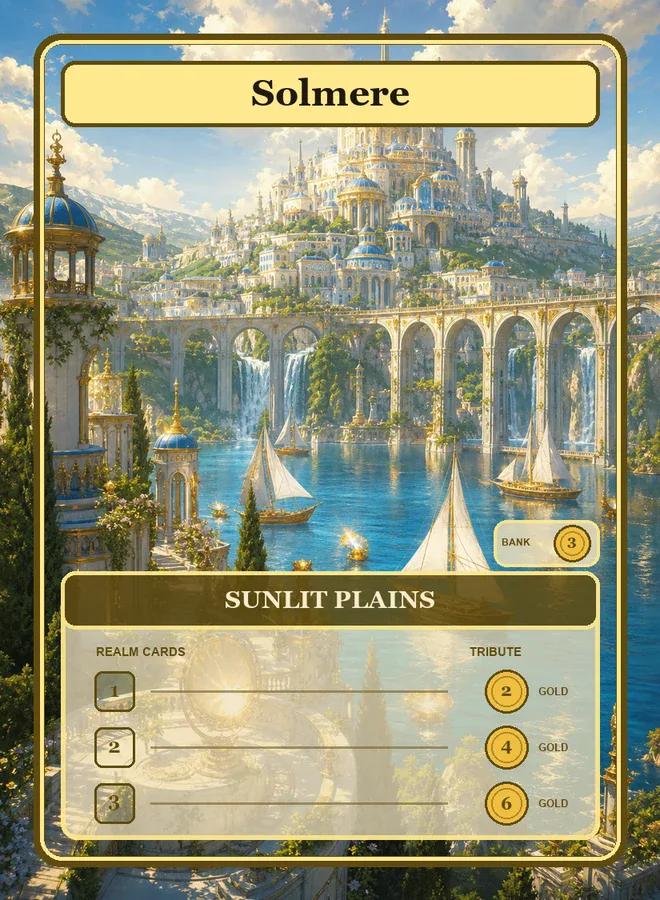
Solmere gathers snowmelt behind a crescent of cream-stone sluices, turning dry acreage into orchards and flax fields. The Merekeepers publish every gate opening in advance, but forged schedules have enriched speculators and ruined villages downstream. Control of the water ledger is worth more than control of the ceremonial manor above it.
The Emerald Marches follow the Green Measure, a boundary negotiated between farming shires and the Thalen, the Realm's elven tower-guild culture. Living marker trees shift when soil, water, or old agreements are abused. Timber, medicines, and hidden roads make the Marches prosperous; their moving borders make conquest easy to declare and nearly impossible to finish.
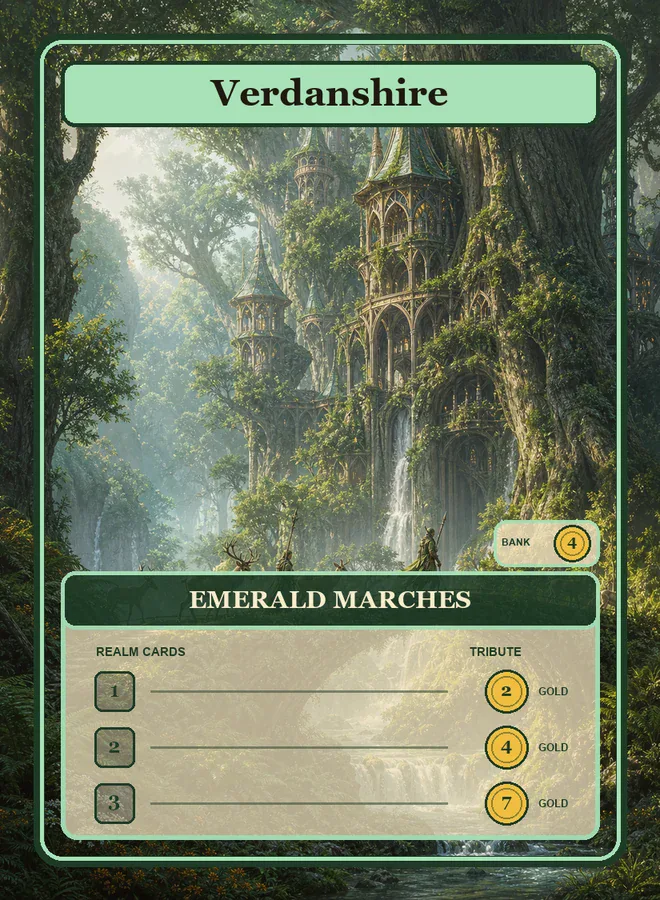
Verdanshire is a patchwork of orchards, forest lanes, and low halls roofed in living moss. Its shire moot grants timber only after new boundary trees survive one full season. Merchant houses offer gold for faster permits; villagers remember the landslides that followed the Crown's last hurried timber cutting.
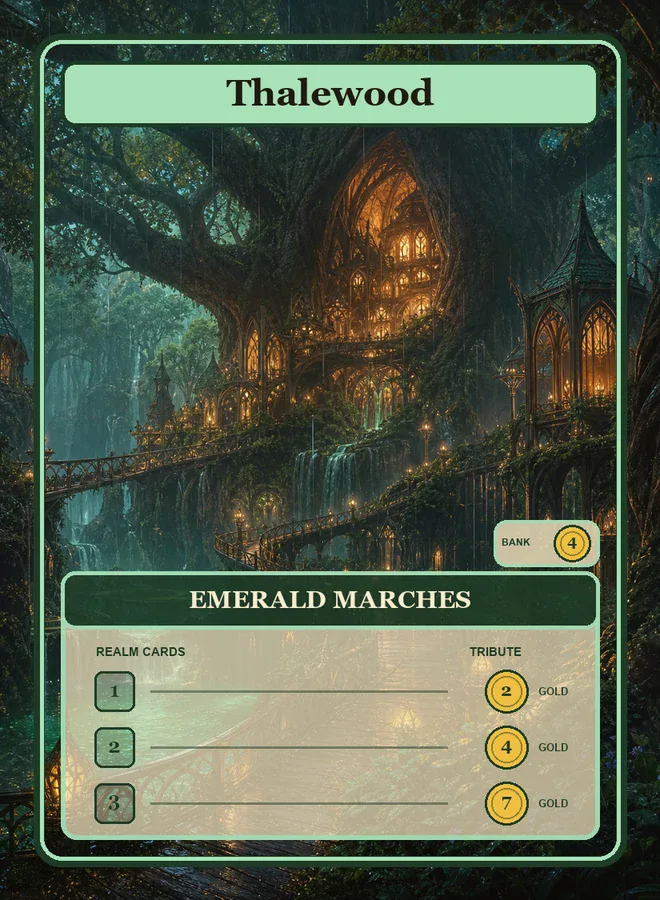
Thalewood's pale towers are shaped over generations by Thalen guilds whose plans outlive their architects. Resin, medicines, and mapwood leave through guarded canopy roads. One tower now leans toward a landslide scar where every boundary tree died, dividing those who fear collapse from those who would move the Green Measure.
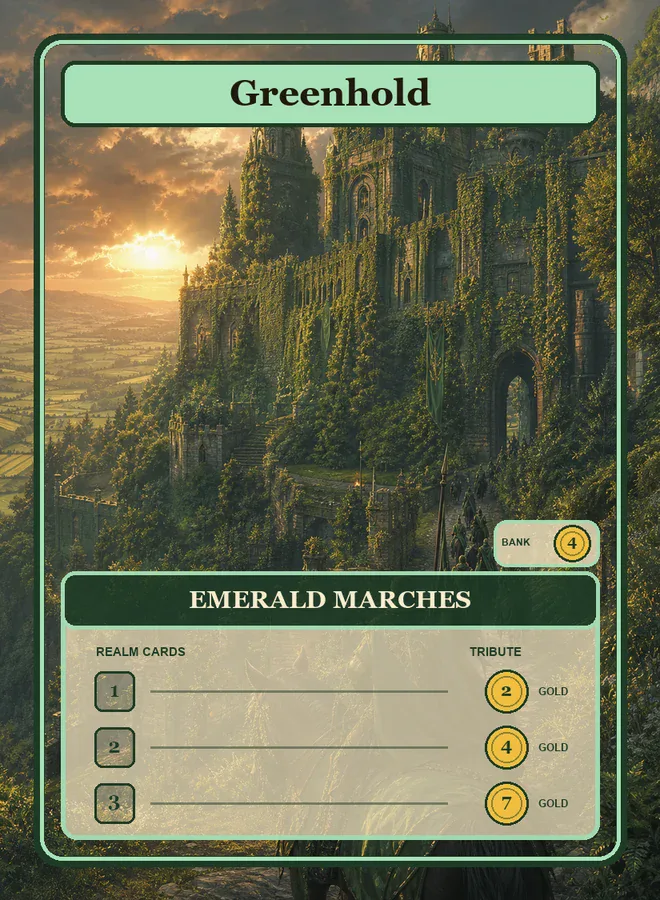
Greenhold's root vaults hold its entire hill together. Marchwardens open them as shelters during invasion while weighted living ramparts close paths behind retreating families. Capturing the gatehouse wins little: only crews trained in the root works can shift those loads without collapsing the fortress upon themselves.
Avarra was governed from twin capitals so no sovereign could rule from one city alone. Caldwyn held coin, civil law, and royal decrees; Thorneveil kept coronation oaths, sanctuary rolls, and the royal dead. The Crownfall left each city with half the paired seal. A claimant may command either capital, but only both can prove a lawful succession.
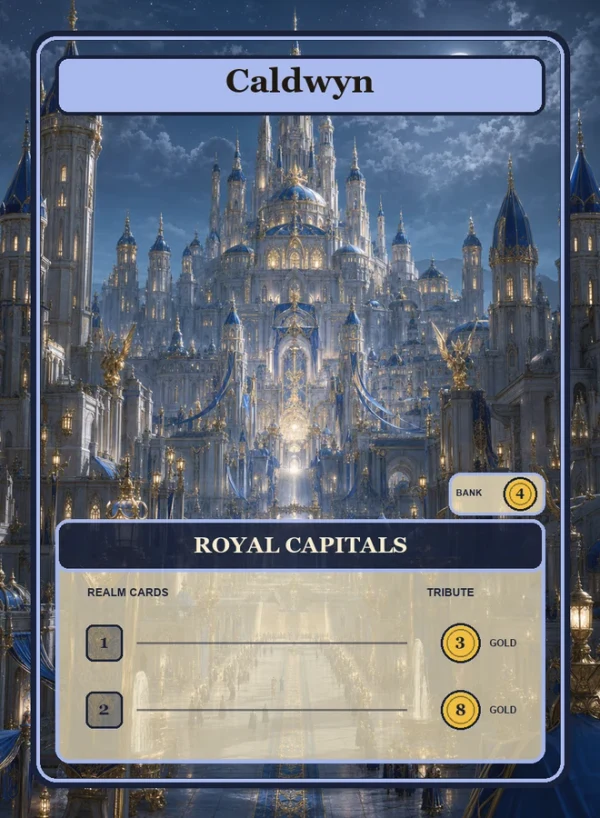
Caldwyn mints interregnum coin: lawful gold bearing no ruler's face. The Hall of Measures will strike a sovereign portrait only when both halves of Avarra's paired seal are presented. Until then, blue-stone ministries issue temporary decrees that merchants obey, judges contest, and counterfeiters eagerly imitate.
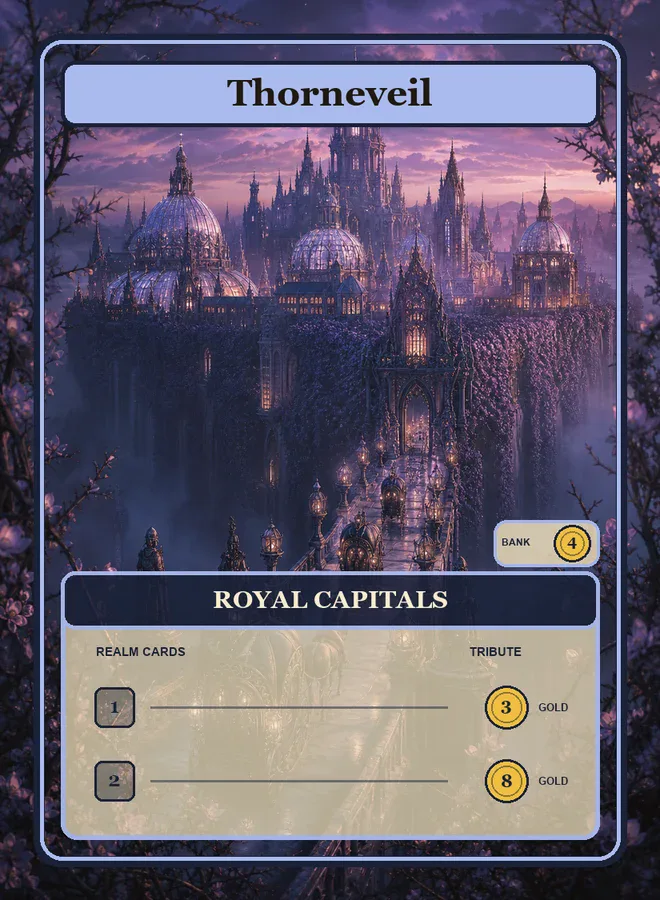
Thorneveil's moonlit towers hold the High Church's Bell Archive and largest sanctuary. During the Crownfall, its clergy sheltered royal soldiers and rebels, then refused to ring either side's coronation. Some prelates now sell access to sealed succession rolls; quiet archivists copy them so proof of the throne cannot simply be purchased.
The Skyship Routes are a Realm of charters rather than soil. Four charter companies maintain the wind lanes, cloud harbors, depot rights, and beacon codes crossing the former kingdom. Free captains resist royal seizure while merchant houses buy influence at every mooring. United, the four routes determine how quickly armies, treasure, and warnings cross fractured Avarra.
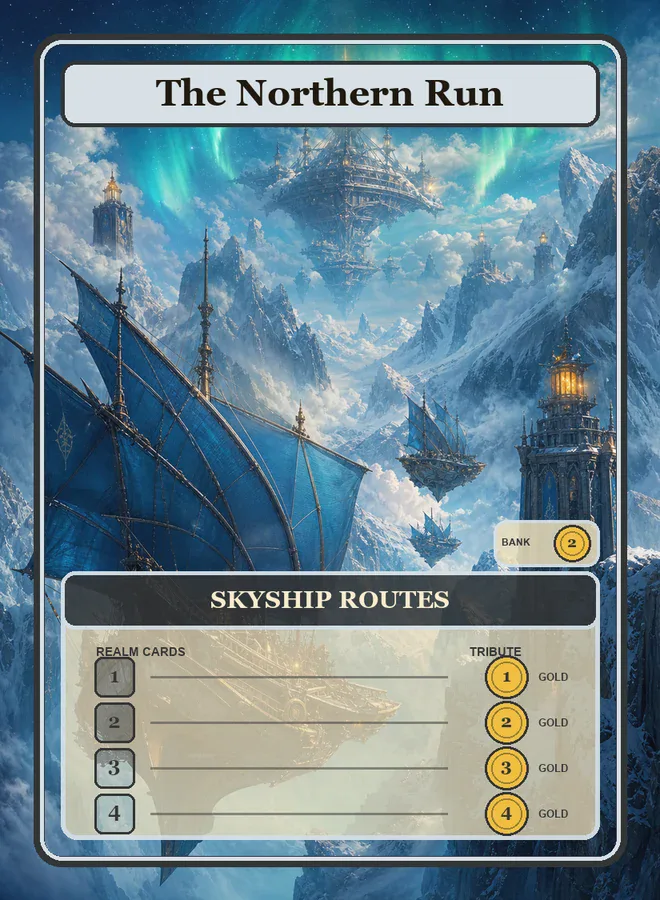
Ice skins a hull within minutes on the Northern Run. Convoy masters fly steel-grey ships close enough to pass tether lines, trading Frostbound winterglass craft for grain, medicine, and forge coal. The route's aurora beacons are reliable, but a captain who abandons a slower vessel loses northern mooring rights for seven winters.
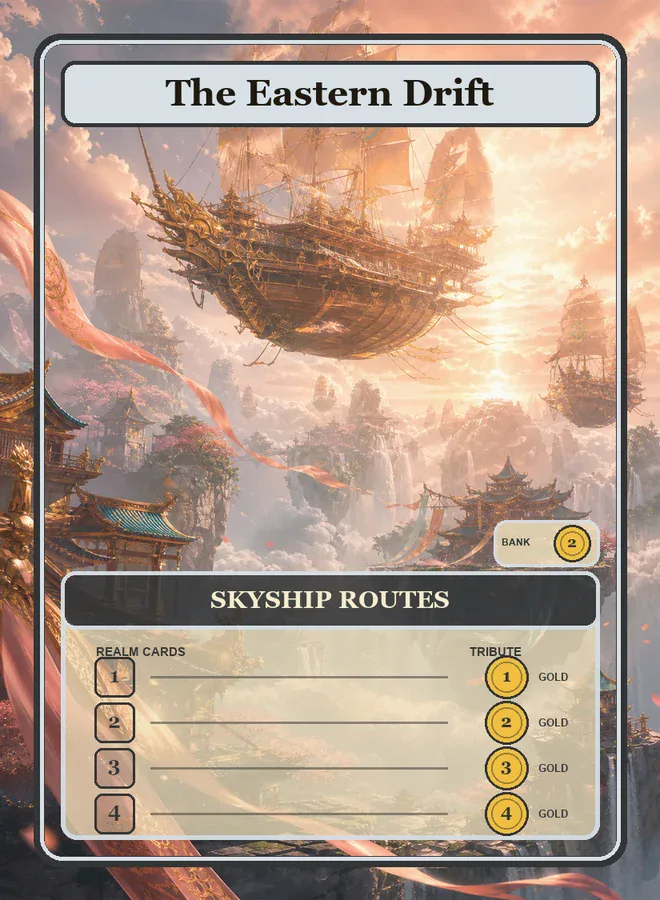
The Eastern Drift rides a warm current above the Glades, where rose-colored pollen exposes invisible crosswinds. Pilots read its spirals from open decks while sealed couriers fly blind and fast. Glade circles permit only three cloud harbors, making every additional landing either an emergency, a trespass, or a carefully disguised theft.
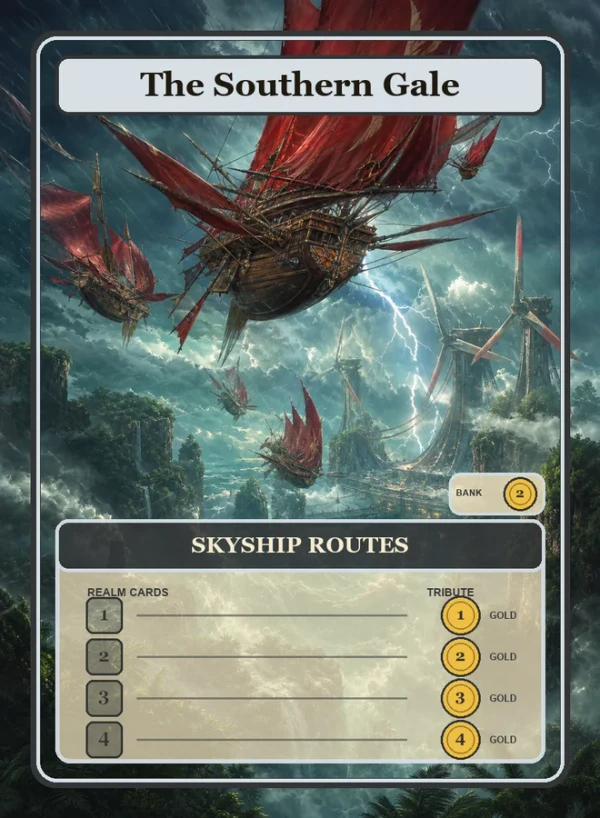
Heat rising from the Glass Road lifts heavily laden ships into the Southern Gale. Mirror League flashes guide them between sandstorms and caravan wells. False beacons once delivered an entire gold convoy to raiders; captains now demand three matching signals before descending, even when thirst argues otherwise.
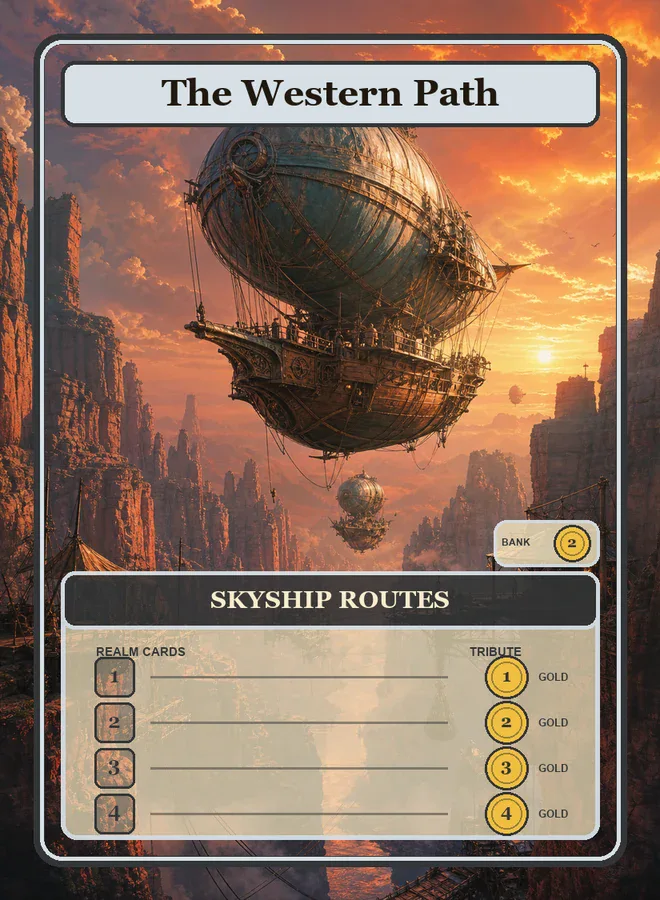
The Western Path threads Crimson beacon towers and the first squalls off the Stormbound sea. Avarra once requisitioned every westbound ship for war; harvest cargo spoiled at shuttered cloud docks. Free captains still keep the torn order in their charter chests and refuse military seals unless all four charter companies consent.
The Arcane Nexus predates Avarra, though the Crown surrounded its mechanisms with licenses and the High Church built schools to study them. The Aether Well gathers power; the Arcane Forge gives that power durable form. Separately, licensed power and pattern-work enrich their keepers. Joined, they can awaken dormant Avarran mechanisms still bearing the Nexus mark—or deny power to every such link.
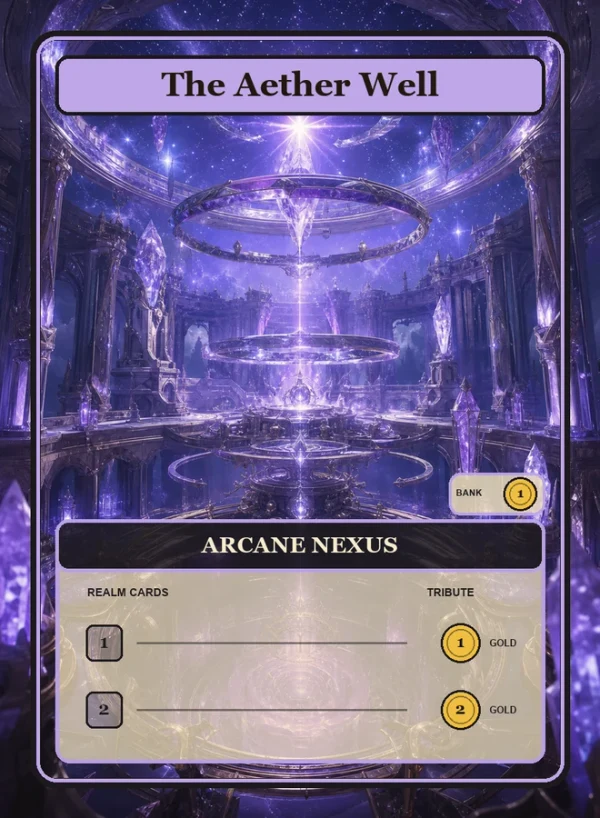
The Aether Well draws a measured tithe of motion from gates, wheels, and clocks linked to its violet rings. Its stored current can light workshops for months, but a sudden withdrawal slows every contributing mechanism toward stillness. Keepers divide control of the master valve so no decree can drain the network at once.
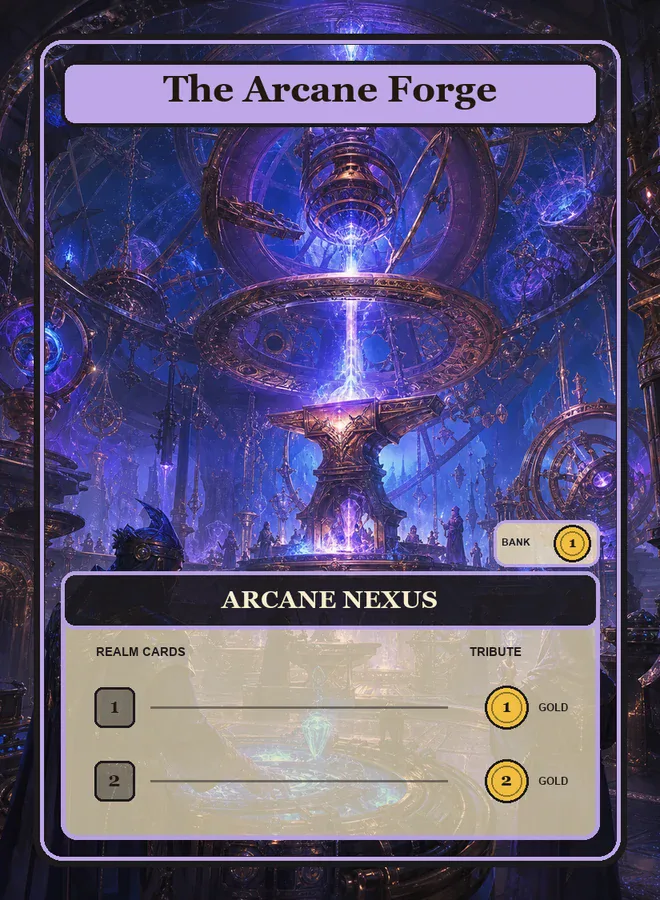
Within a charcoal vault, articulated gold arms press waking patterns into metal without melting it. Bridges remember unbroken spans, locks reject copied keys, and armor returns to its fitted curve. Each work requires both a hidden pattern and its waking sequence, so stealing one without the other is useless.
The Frostbound Clans preserve agreements in winterglass tablets whose cut lines sing when struck. Clan speakers compare those tones before trade, marriage, or war, making altered oaths difficult to hide. Blue iron, cold-vault storage, and northern pass tolls fund their Gold tribute. As the Crownfall began, Avarra lost its final northern campaign trying to suppress tablets that proved the Crown had broken faith first.
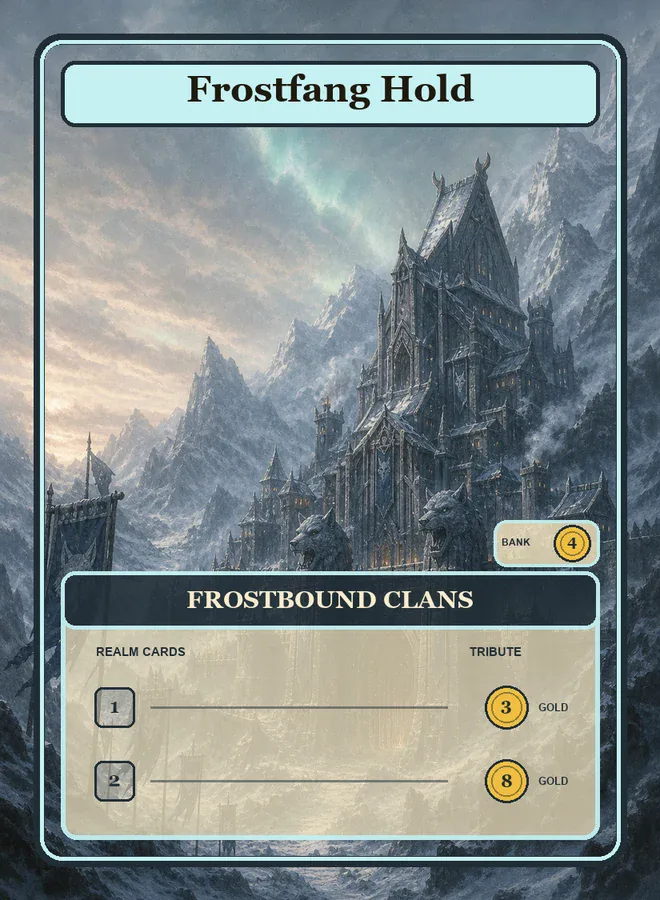
Frostfang Hold stands beneath twin avalanche chutes. Its wolf standards mark rescue companies rather than noble bloodlines; each company maintains one snow wall, one amber-lit longhall, and one horn sequence for collapse. During siege, crews can break the retaining walls to release the chutes across the southern approach—but only after the last outlying household answers the muster horn.
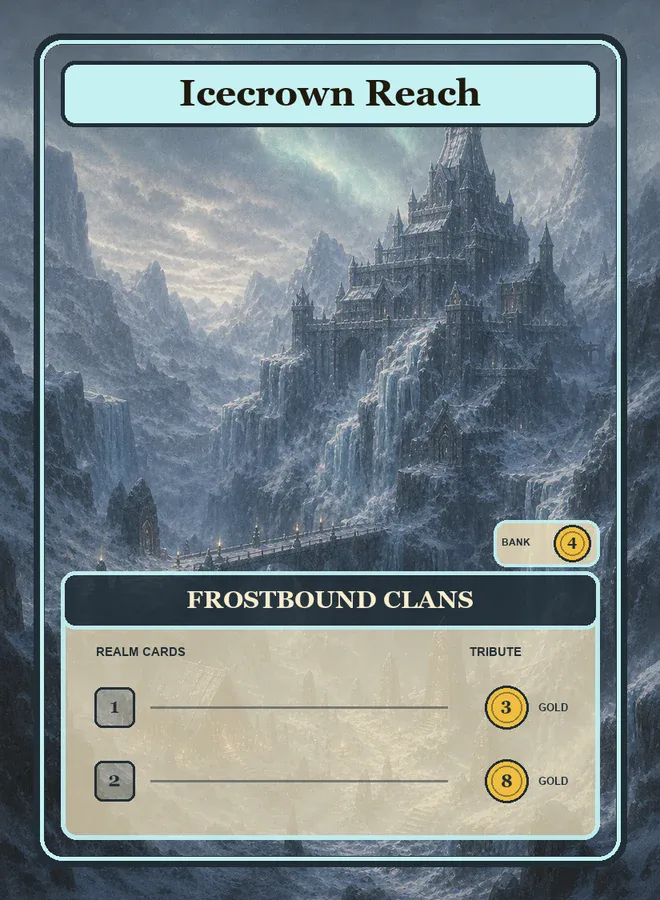
Icecrown Reach guards the glacial pass where blue iron leaves the north. Treaties cut into translucent tablets line its aurora-lit hall, and their tones settle disputes no living witness remembers. Warmer summers have begun detuning the oldest cuts, forcing rival clans to decide which promises deserve recutting—and whose version the new glass should preserve.
Under the Beacon Compact, Stormwatch warns every vessel without judging its banner; Silverwake launches rescue before hearing salvage claims. Captains post seasonal Gold bonds, forfeited only when paired ledgers prove they ignored a reachable call. During Avarra's western requisition, the Crown reserved lights for warships; every tower burned for all sails instead. Only tower and harbor together can enforce the Compact.
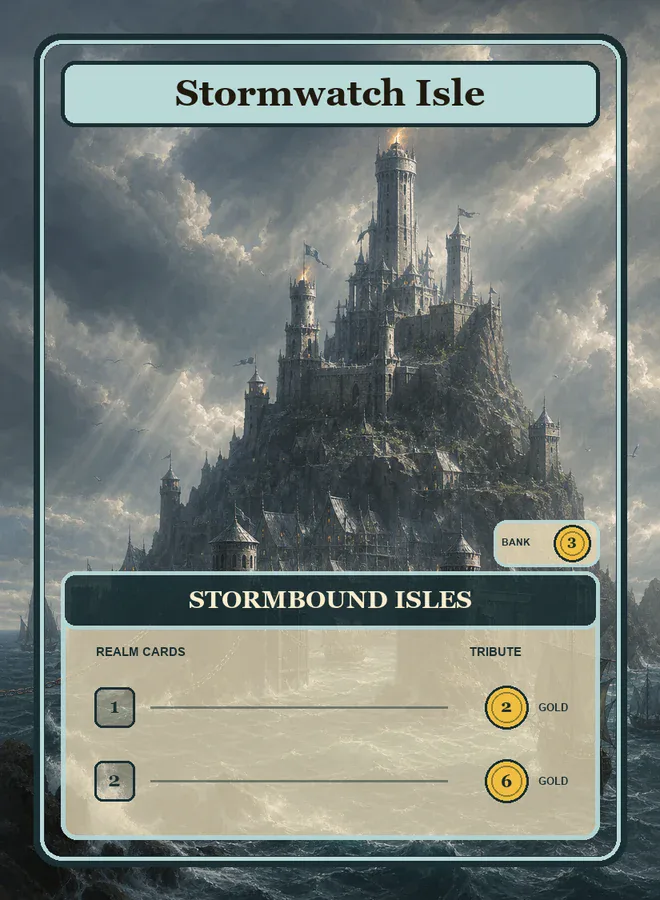
When the Black Squall tore the great lens from Stormwatch's charcoal sea-fort, beacon apprentices angled polished shields into its empty frame; each lightning flash carried their improvised code and brought thirty ships home. The restored tower hangs one cracked shield above its gate, reminding every Bellwarden that warning is a public promise, not a fortress privilege.
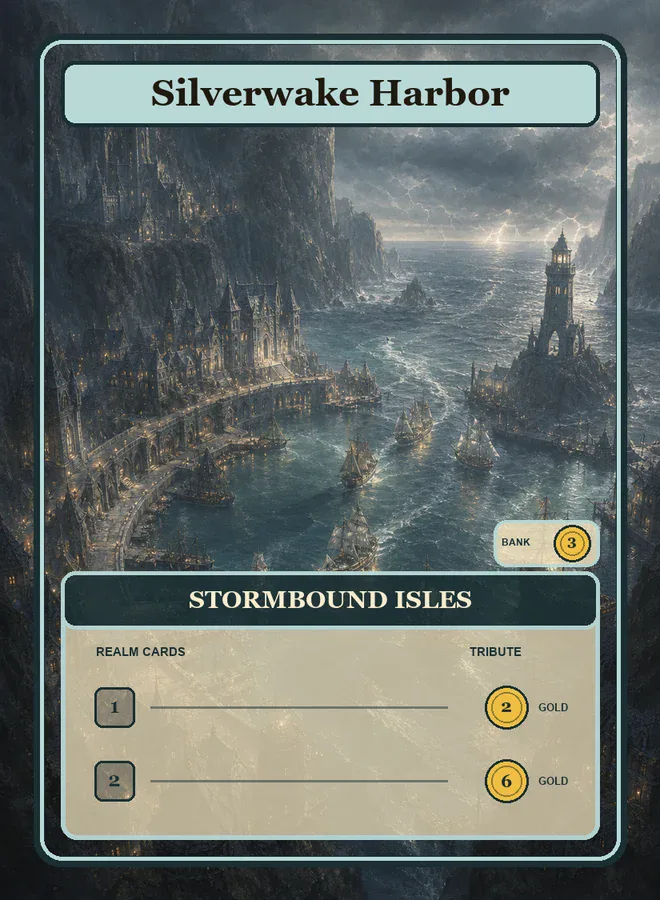
Silverwake Harbor is cut into a charcoal cliff above shell beds that silver each departing wake. Chain lifts carry cargo between piers and storm vaults. Its court awards salvage only after crews prove they answered the nearest beacon's distress bell, so wealthy captains maintain rescue craft—from honor, law, or fear of losing a prize.
Six claimants sit down. One leaves crowned. Play them yourself or against the computer — each has their own voice, and each of them has something to say about how your turn went.
“Love or war, I’ve got you.”
Aurelia inherited a kingdom held together by ceremony, debt, and dangerous promises. She learned early that devotion can win what armies cannot—and that a smile is often the sharpest weapon in the room. Her court adores her; her rivals rarely realize they have surrendered until they are already kneeling.
“We live to serve the path of life. Are you ready to help?”
Rowan once guarded the old roads where maps end and the Elderwood begins. During the Ashen Siege, he held a mountain pass with a handful of scouts and a single quiver. He has little patience for royal theater, but an unbreakable loyalty to anyone placed under his protection.
“Go ahead and try me. I’m always ready to strike.”
Seraphine was raised among star charts that recorded futures no sovereign was meant to read. She foresaw the fracture of the Twelve Realms and walked away from the Archive before its masters could silence her. Seraphine never threatens twice; by the time an enemy moves, she has already seen how the contest ends.
“I’ve killed better than you. Do you really think you have what it takes?”
Idris was a prince until a palace coup turned his coronation into a massacre. He crossed the Sunscar alive, returned at the head of an army, and reclaimed his name without reclaiming his mercy. He respects courage, despises hesitation, and treats every contest as a trial by fire.
“They say I’m a bit… dark.”
No chronicle agrees on where Nyx was born—or whether Nyx was born at all. They emerged from the Court Beneath carrying the private sins of six royal houses and the keys to doors that do not exist by daylight. Nyx finds terror honest, secrets useful, and the shocked laughter of enemies absolutely delightful.
“If you’re looking for a bit of freedom, I’m your man. Let’s end the tyranny.”
Cassian began as a navigator on a royal prison galley and ended the voyage as captain of a liberated fleet. He flies no king’s colors and recognizes no law that demands obedience without justice. To the oppressed he is a folk hero; to every throne in the Twelve Realms he is a storm gathering offshore.
The opening anthem and the eleven-track in-game rotation. Press play on any row — one plays at a time.
{{ audioNote }}
One purchase per storefront, no subscription, no energy timers, no ads. The same 126-card deck on every platform.
Windows and Mac. Wishlist now — the store page is live ahead of release.
Steam page in preparationDRM-free desktop build, updated the same day as every other platform. Includes the print & play PDF.
Buy on itch.ioiPhone and iPad, in review. Solo against the rival rulers, or pass-and-play a table on one device.
Submitted for reviewAndroid phones and tablets. Same build, same price, no in-app purchases of any kind.
In testingSigned Android download for sideloading, with the SHA-256 checksum published beside it.
Download →The full 126-card deck, printed and boxed and shipped to your door. $38.99.
Buy the boxed game →
126 cards, the same deck the digital game runs on, printed and boxed and shipped to your door — available now.
Prefer paper tonight? The print-and-play edition is the full deck as a PDF.
The print-and-play edition is the full deck as a PDF — sent the moment you sign. Prefer it boxed? The printed edition is available now.
{{ subscribeNote }}